


Deciding between squeeze casting and high pressure die casting for your manufacturing projects can be difficult, because these two processes look similar on the surface. However, the final part quality, cost, and even whether you can heat-treat it are worlds apart.
In this guide, we will show you exactly how these manufacturing processes compare on porosity, strength, heat treatment, cost, and design limits—so you can make the right call for your production program.
Quick Verdict: Which One Should You Choose?
Choose Die Casting (HPDC) if you need high-volume, thin-walled parts (like housings, connectors, heat sinks) with tight cosmetic tolerances, and you do not require T6 heat treatment.
Choose Squeeze Casting if your part must withstand high fatigue loads, pass pressure-tightness tests, or requires T6 heat treatment—and you are willing to accept a longer cycle time for premium mechanical properties.
Still unsure? Read on and find out more.
How the Two Casting Processes Work
The mechanics of each process set expectations for everything downstream, from internal quality to cycle time. High-pressure die casting fills a cavity fast under injection pressure, while squeeze casting applies sustained pressure as metal solidifies.
What High Pressure Die Casting Does Differently
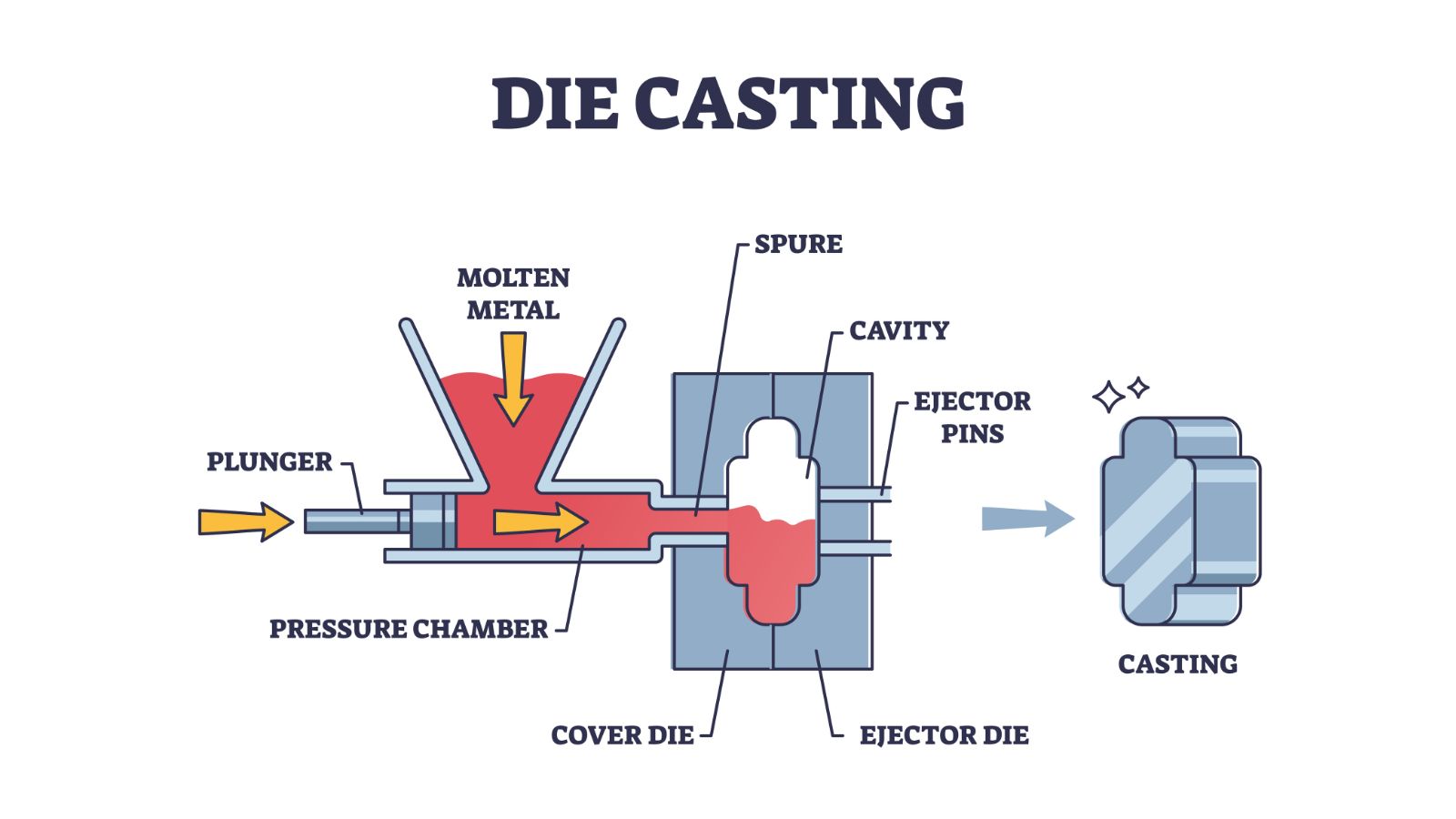
In high pressure die casting process, molten metal is injected into a steel mold at high velocity through a shot sleeve. Injection pressure typically ranges from 10 to 175 MPa depending on alloy and part geometry. The metal fills the mold cavity in milliseconds, which produces excellent dimensional accuracy and fine surface detail.
The trade-off is that fast injection promotes turbulent flow. Air and gas become trapped in the cavity, and that trapped gas becomes internal porosity after the metal solidifies. Pressure is applied during injection but is not sustained through the solidification phase in the same controlled way as squeeze casting.
What Squeeze Casting Means In Practice
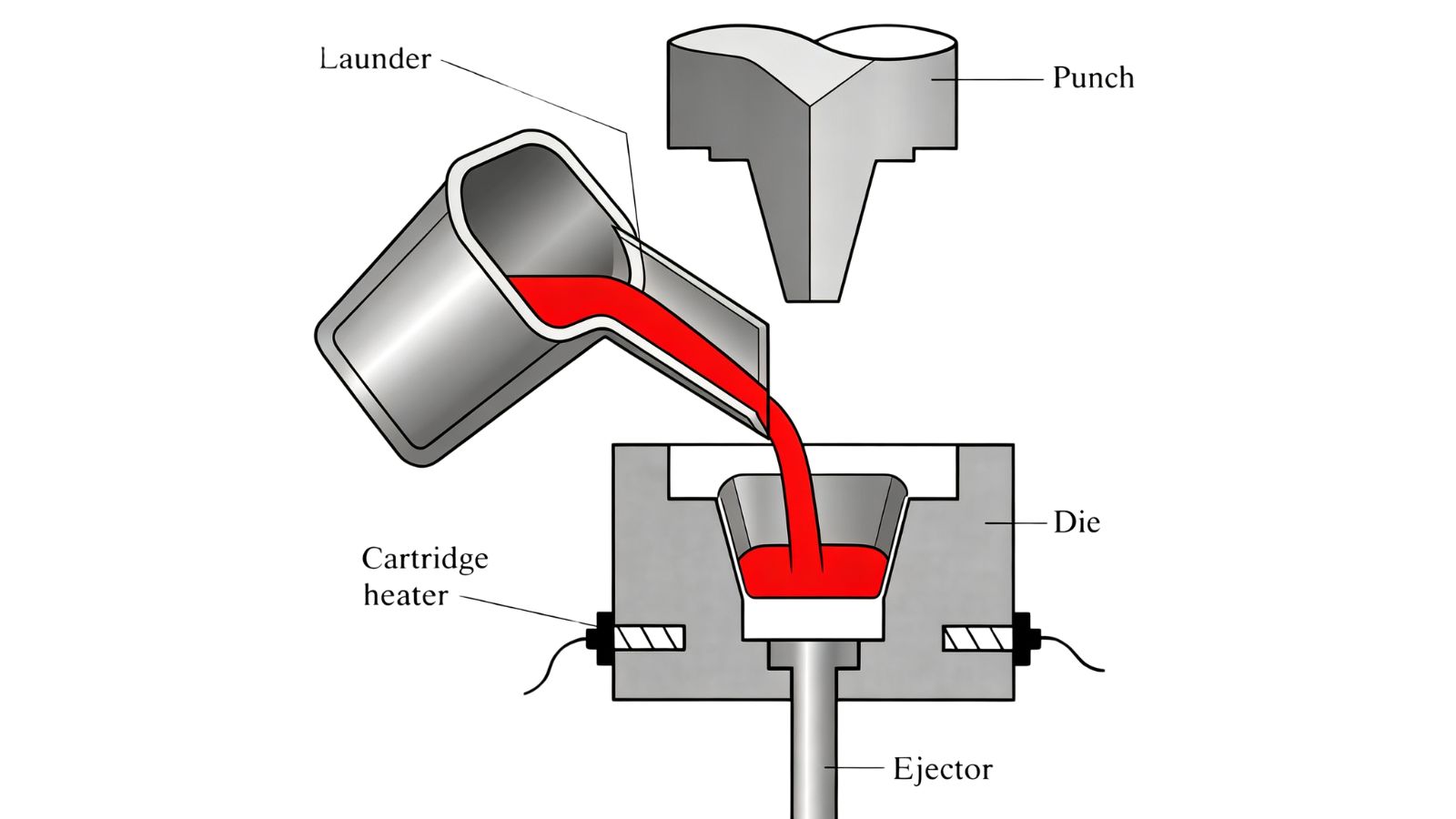
Squeeze casting, sometimes called liquid metal forging, pours molten metal into an open die and then closes a hydraulic press to apply pressure during solidification. That pressure holding phase is what separates it from traditional die casting. The sustained pressure, often between 50 and 150 MPa, forces the metal against the mold walls as it contracts, reducing shrinkage porosity and refining the microstructure.
The slower, controlled fill produces laminar flow rather than turbulent injection. Less air is entrapped, and the resulting casting is denser with fewer internal defects.
Side-by-Side Comparison: Squeeze Casting vs. High-pressure Die Casting
| Comparison Factor | High-Pressure Die Casting (HPDC) | Squeeze Casting (Liquid Metal Forging) |
|---|---|---|
| Fill Velocity | High-speed injection (turbulent flow) | Slow, controlled fill (laminar flow) |
| Pressure Duration | Pressure only during injection phase | Sustained pressure throughout solidification |
| Internal Porosity | Higher gas & shrinkage porosity | Near-zero porosity (dense microstructure) |
| T6 Heat Treatment Compatible? | NO (risk of blistering) | YES (blister-free) |
| Typical Wall Thickness | Thin walls possible (< 2mm) | Thicker sections required (> 5mm) |
| Best Application | High-volume housings, brackets, enclosures | Structural, safety-critical, or hydraulic components |
Porosity, Performance, And Heat Treatment
Internal soundness is one of the most consequential differences between the two processes. Porosity type, distribution, and severity vary significantly based on how metal flows and solidifies.
Why Porosity Forms In Die Casting
In high-pressure die casting, high-velocity injection creates turbulent flow inside the mold cavity. Air and gas get folded into the metal stream before they can escape. As the metal cools, those pockets remain as gas porosity—small voids distributed through the part. Shrinkage porosity can also form where thicker sections cool last without adequate pressure compensation. The result is a part with measurable internal pores that affect structural and pressure integrity, even if cosmetic quality looks fine.
For a deeper dive into how we detect and solve these issues, read our dedicated guide on porosity detection and prevention in die casting.
How Squeeze Casting Closes The Gap
In squeeze casting, sustained hydraulic pressure during solidification closes shrinkage voids as they try to form. The metal is forced against the die surface continuously, accelerating heat transfer and producing a finer, more uniform grain structure. The slower laminar fill also prevents gas entrapment from the start. The result is a denser part with near-zero porosity.
What This Means For Your Part
For non-structural or cosmetic parts, the porosity levels in standard die casting are often acceptable. But for pressure-containing components, fatigue-loaded structures, or parts that must pass X-ray or leak testing, internal soundness becomes critical.
This is also where heat treatment comes in.
High-pressure die cast parts cannot typically undergo T6 heat treatment—internal gas expands during solution treatment and causes blistering.
Squeeze cast parts, with their reduced porosity, tolerate T6 without blistering, achieving higher post-treatment strength.
When heat-treated mechanical properties are specified on your drawing, squeeze casting is the more suitable baseline process.
Design Freedom, Geometry, And Typical Applications
Both processes impose different constraints on part geometry, wall thickness, and feature complexity. The right process depends on what the design actually requires.
Thin Walls Versus Thick Structural Sections
High-pressure die casting handles thin-walled parts well. The high injection velocity and pressure push metal into fine features and thin sections before solidification begins. Wall thicknesses below 2 mm are practical in standard HPDC.
Squeeze casting is better suited to thicker sections where shrinkage is otherwise a problem. Very thin walls are more difficult to fill under the slower, pressure-applied squeeze casting sequence.
Complex Geometries and Near-Net-Shape Potential
High-pressure die casting excels at near-net-shape production of geometrically complex parts with undercuts, cores, and intricate external features. The precision of the die and the speed of injection reproduce fine detail consistently.
Squeeze casting also produces near net shape parts, but internal feature complexity is more constrained.
Both processes reduce secondary machining compared to sand or permanent mold casting, but HPDC typically delivers tighter initial dimensional accuracy.
Common Automotive and Industrial Use Cases
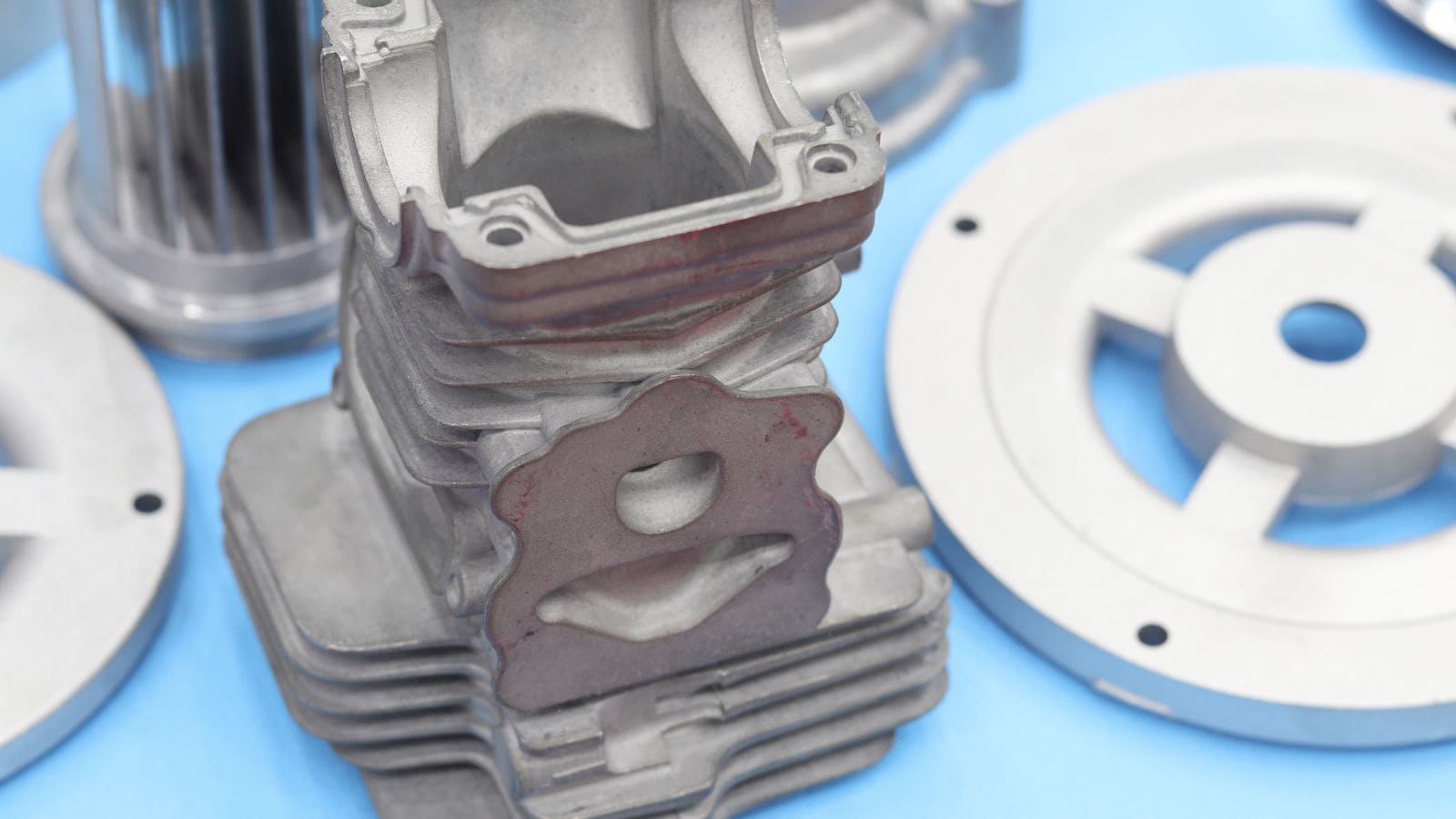
High-pressure die casting is the standard process for heat sinks, motor housings, brackets, electronic enclosures, and transmission housings where surface finish, dimensional accuracy, and volume matter most.
Squeeze casting targets applications where mechanical integrity is the priority: brake calipers, steering knuckles, control arms, and hydraulic components. Aerospace components in aluminum and magnesium alloys are also candidates for squeeze casting, where strength-to-weight ratio and fatigue resistance are specified.
Cost Factors of Both Casting Methods
Process selection is rarely made on quality alone. Production volume, tooling investment, and cycle time all affect commercial viability.
High-pressure die casting tooling is generally more expensive upfront. HPDC dies require premium tool steels and precise cooling channel machining to handle high injection pressures and long production runs.
Squeeze casting dies are simpler in design and cost less initially, but this advantage must be weighed against the process’s longer cycle time.
The Hidden Cost: Why Squeeze Casting Is NOT Always Better
Some suppliers will tout squeeze casting as the “superior” process. But here is the truth they won’t always tell you:
-
Longer Cycle Time: Squeeze casting takes 2 to 5 minutes per shot, versus 30–120 seconds for HPDC. At scale, that means significantly fewer parts per hour.
-
Higher Tool Wear: The sustained hydraulic pressure places extreme stress on the die, leading to shorter mold life compared to standard HPDC tooling.
-
More Expensive Per-Part Cost: For annual volumes above 50,000 pieces, the slower cycle time often makes squeeze casting 30% to 50% more expensive per part than HPDC.
So here is our honest advice: If your part is thin-walled, under 2 kg, and does not require T6 treatment, die casting is the economically and technically superior choice. Moldie specializes in high-volume HPDC, and we can help you discern if squeeze casting is overkill for your design.
A Practical Selection Framework
To wrap up this blog, let us retrace the quick verdict in the beginning with what we learn in the blog to form a complete practical selection framework:
Choose High-Pressure Die Casting (HPDC) if:
-
Your annual production volume is high (typically above 50,000 pieces)
-
Your part has thin walls (below 2 mm) or complex external features
-
You require tight dimensional tolerances and smooth surface finishes
-
Your application does not require T6 heat treatment
-
You are working with aluminum alloys like A380 or A383
-
Typical parts: housings, covers, brackets, electronic enclosures, heat sinks
HPDC delivers fast cycle times, consistent cosmetic quality, and excellent cost-efficiency at scale. It is difficult to beat commercially for high-volume OEM/ODM program.
Choose Squeeze Casting if:
-
Your part must pass pressure-tightness tests or leak testing
-
The application involves high cyclic loads or fatigue stress
-
Your design requires T6 heat treatment to achieve maximum mechanical properties
-
Internal density and structural integrity are non-negotiable
-
Your annual volume is lower (under 50,000 pieces), offsetting longer cycle times
-
Typical parts: brake calipers, steering knuckles, control arms, hydraulic bodies, aerospace components
Squeeze casting justifies its longer cycle time and higher per-part cost when mechanical reliability is the top priority. In some geometries, squeeze cast aluminum parts can approach forging-level fatigue resistance.
Get Data-Driven Answers from Moldie
If you still wish to consult experts on your specific projects or parts, Moldie is more than willing to help. We are a dedicated high-pressure die casting manufacturer serving automotive, industrial, and electronics sectors, and more.
Moldie combines CAD/CAM/CAE simulation with in-house mold manufacturing. CMM and X-ray inspection for every program. Send your 3D file to request a quote, and let us help you choose the process that fits your part!