


High pressure die casting is widely used when a metal part must combine complex geometry, thin walls, consistent dimensions and economical high-volume production. It can replace multiple machined or assembled parts with one near-net-shape casting. This guide explains the HPDC process, benefits, materials, applications and the role of professional mold engineering.
What Is High Pressure Die Casting?
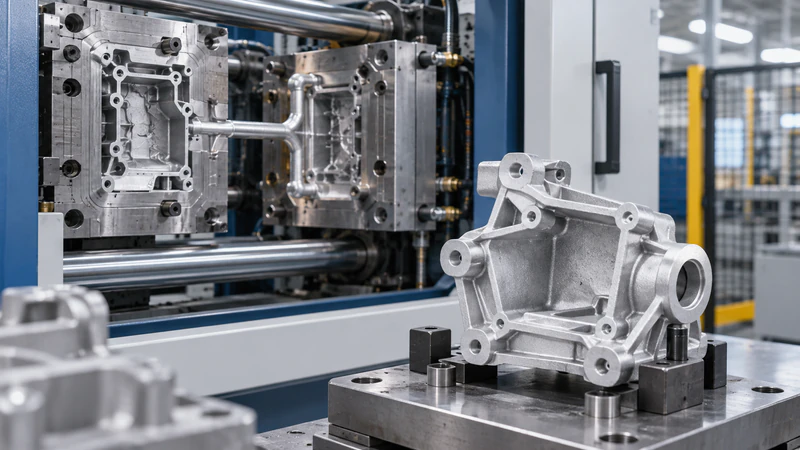
High pressure die casting (HPDC) is a manufacturing process in which molten non-ferrous metal is injected at high speed and pressure into a reusable steel die. The metal fills the cavity, solidifies rapidly and reproduces its shape. The die then opens, and ejector pins release the casting.
Unlike sand casting, HPDC uses a permanent precision tool. It suits medium- and high-volume programs because the same die repeatedly forms detailed components with good consistency.
How Does the HPDC Process Work?
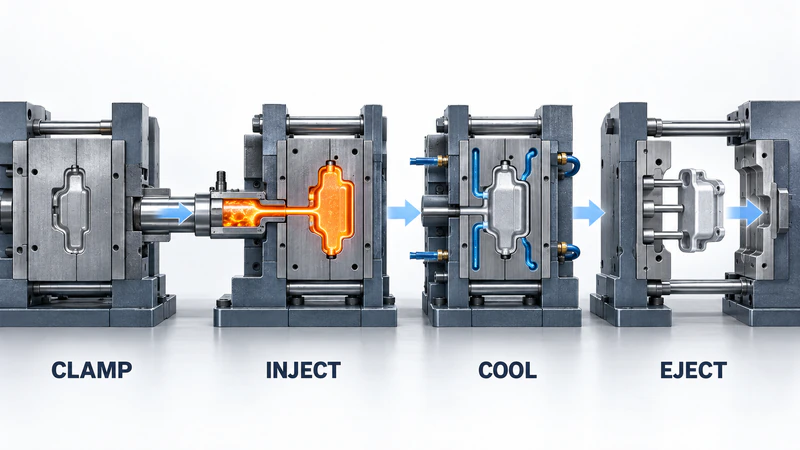
A typical high pressure die casting cycle has six main stages:
- Die preparation: The cavity is cleaned and sprayed with a controlled quantity of release agent. Cooling or heating circuits bring the die to its operating temperature.
- Clamping: The cover and ejector halves close and are held together with sufficient clamping force to resist cavity pressure.
- Metal dosing: A measured amount of molten aluminum, zinc, magnesium or another suitable alloy enters the injection system.
- Injection and intensification: A plunger moves the metal through the runner and gates. It accelerates during final filling so the alloy reaches thin and intricate areas before freezing. Pressure is then maintained during early solidification.
- Cooling and ejection: Internal channels remove heat. Once the casting can hold its shape, the die opens, slides retract and ejector pins release the shot.
- Trimming and finishing: The runner, gates, overflows and flash are removed. CNC machining, deburring, coating, plating, painting or assembly may follow.
Injection speed, pressure, temperature and cycle time must be selected around the alloy, part, machine and mold.
Hot-Chamber vs. Cold-Chamber HPDC
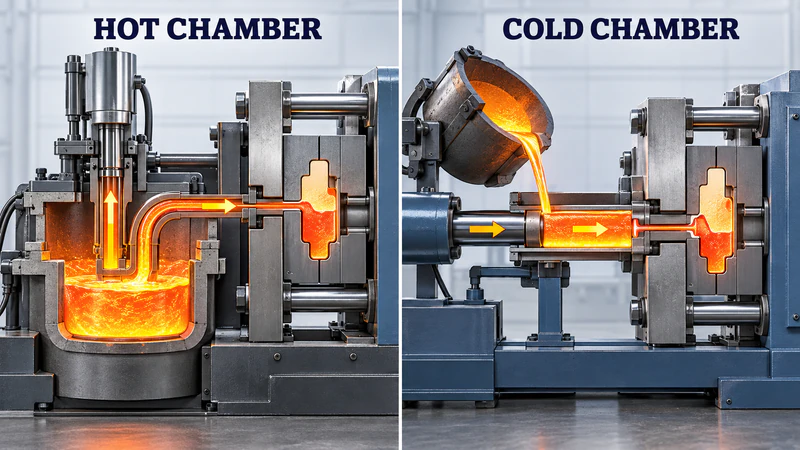
In hot-chamber die casting, the injection mechanism is immersed in the molten alloy, eliminating a separate ladling step. It is commonly used with zinc and selected magnesium alloys.
In cold-chamber die casting, alloy from an external furnace is transferred into a shot sleeve and injected by a plunger. Aluminum normally uses this process.
The choice affects cycle time, tooling layout, machine selection and the alloys that can be processed. Moldiecasting operates hot-chamber machines for zinc and magnesium work and cold-chamber machines for aluminum components.
Advantages of High Pressure Die Casting
HPDC offers several benefits for the right production program:
- High productivity: Rapid cycles and automation make it efficient for repeat production.
- Complex shapes: Thin walls, ribs, bosses, lettering and detailed surfaces can be created in one operation.
- Dimensional consistency: A precision steel die provides repeatable geometry from shot to shot.
- Good surface finish: Cast surfaces can often be used directly or prepared efficiently for decorative and protective finishes.
- Less machining: Near-net-shape production reduces material removal from critical bores, sealing faces and mounting features.
- Part consolidation: Multiple fabricated pieces may be redesigned as a single casting, reducing fasteners, joining and assembly.
- Lower unit cost at volume: Although tooling requires an initial investment, its cost is distributed across the production run.
Limitations and Quality Risks
Precision tooling makes the initial cost higher than expendable-mold processes, so very small production runs may not justify a production die.
Porosity is another important consideration. The high filling speed can trap air, while uneven solidification can create shrinkage voids. Porosity may reduce pressure tightness or complicate welding, heat treatment and deep machining. Proper runners, gates, overflows, vents, vacuum assistance and process control help manage these risks.
The die experiences thermal cycling, pressure, erosion and possible metal adhesion. Tool steel, heat treatment, cooling, maintenance and casting alloy affect tool life. Buyers should therefore compare engineering and validation—not simply mold price.
Common HPDC Materials
Aluminum Alloys
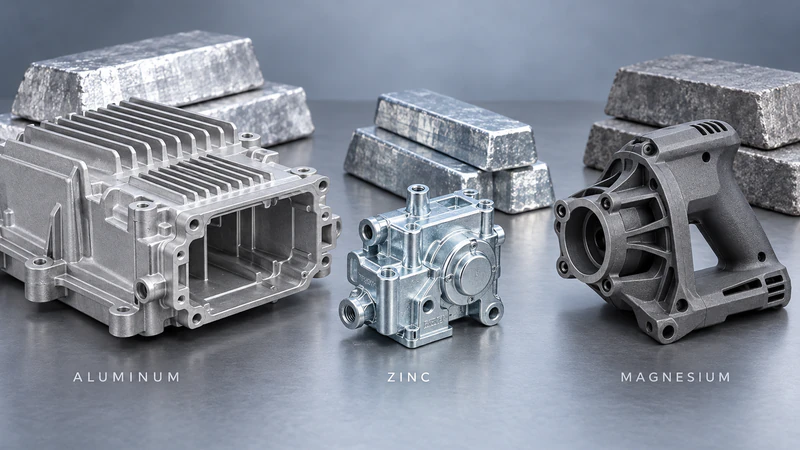
Aluminum combines low weight with strength, corrosion resistance and thermal conductivity. It is used for motor housings, brackets, heat sinks, lighting bodies and electrical enclosures. Common alloys include A360, A380, A383 and A413.
Zinc and Zamak Alloys
Zinc provides excellent castability, precision and surface quality. Its fluidity supports thin sections and fine detail, while Zamak alloys suit locks, handles, bathroom accessories, window fittings and compact components.
Magnesium Alloys
Magnesium is the lightest commonly used structural metal. AZ91D balances strength and corrosion resistance, while AM60B and AM50 offer greater ductility and impact absorption. Applications include brackets, tool bodies, electronic housings and automotive components.
Alloy selection should consider more than price per kilogram. Product weight, operating temperature, mechanical load, corrosion, conductivity, appearance, secondary machining and expected production volume all matter.
Products and Industries Suited to HPDC
High pressure die casting is most attractive when demand is repeatable and the component benefits from complex features or reduced machining. Typical applications include:
- Automotive and electric-vehicle housings, brackets and structural components
- Train, bicycle and lawn-equipment parts
- LED lighting bodies and heat-dissipation components
- Electronic, telecom and power-control enclosures
- Pump, motor and gearbox housings
- Locks, bathroom hardware, handles and window fittings
- Consumer-product and power-tool components
Very low demand, frequent design changes, mandatory ferrous material or extreme internal-integrity requirements may point toward another process or a specialized high-integrity HPDC method.
Why HPDC Mold Design Matters
An HPDC die is more than a negative copy of the finished part. It is a coordinated system that controls metal flow, air removal, heat transfer, solidification and ejection.
The runner and gates determine where metal enters and how the cavity fills. Poor placement can cause cold shuts, turbulence, trapped air or local die erosion. Overflows and vents collect the last metal and give displaced air an escape path. Cooling channels balance temperature, influence cycle time and reduce hot spots, shrinkage and distortion. Slides create side holes or undercuts, while ejector placement must remove the casting without deformation or unacceptable marks.
Early design for manufacturability and mold-flow analysis can expose risks before steel is cut. Fill-time, velocity, air-pressure, temperature-distribution and shrinkage analysis help engineers refine the feed system and cooling layout. Part designers can also improve castability by using reasonably uniform walls, smooth transitions, radii, adequate draft and ribs instead of unnecessary thick sections.
Start Your HPDC Project with Moldiecasting
Moldiecasting has specialized in die casting molds and parts since 2008. Its services cover mold design and engineering, die manufacturing, aluminum, zinc and magnesium casting, CNC machining, surface treatment, assembly and packaging.
To obtain an accurate evaluation from Moldiecasting, provide your 2D drawing, 3D model, desired alloy, annual volume, critical tolerances, appearance requirements, machining areas, testing needs and target schedule. These inputs allow the Moldiecasting engineering team to assess part castability, machine size, mold structure, cavity count and downstream operations.
Planning a high pressure die casting project? Contact Moldiecasting to request a manufacturability review and a customized solution from HPDC mold design through finished, packaged parts.